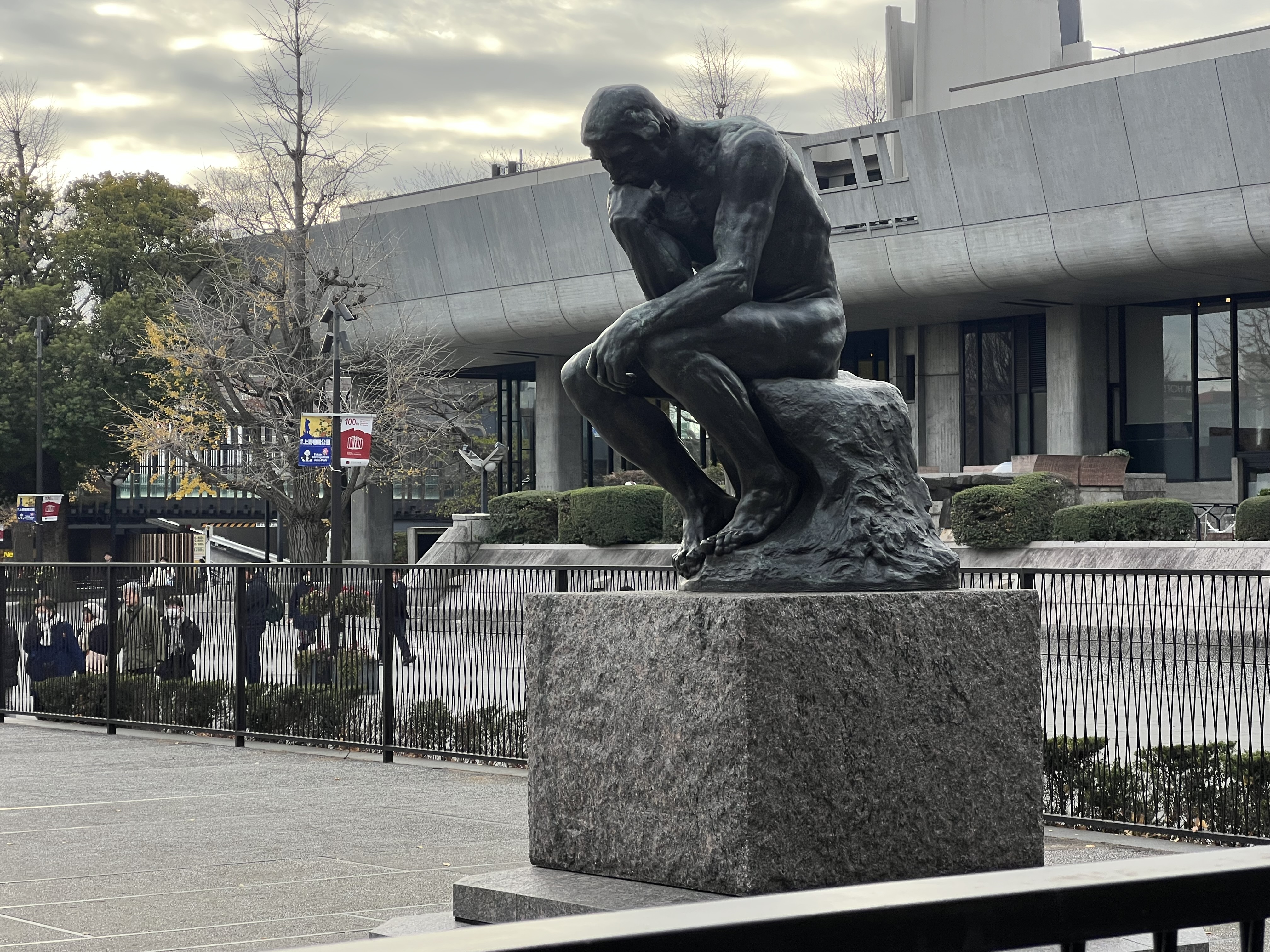
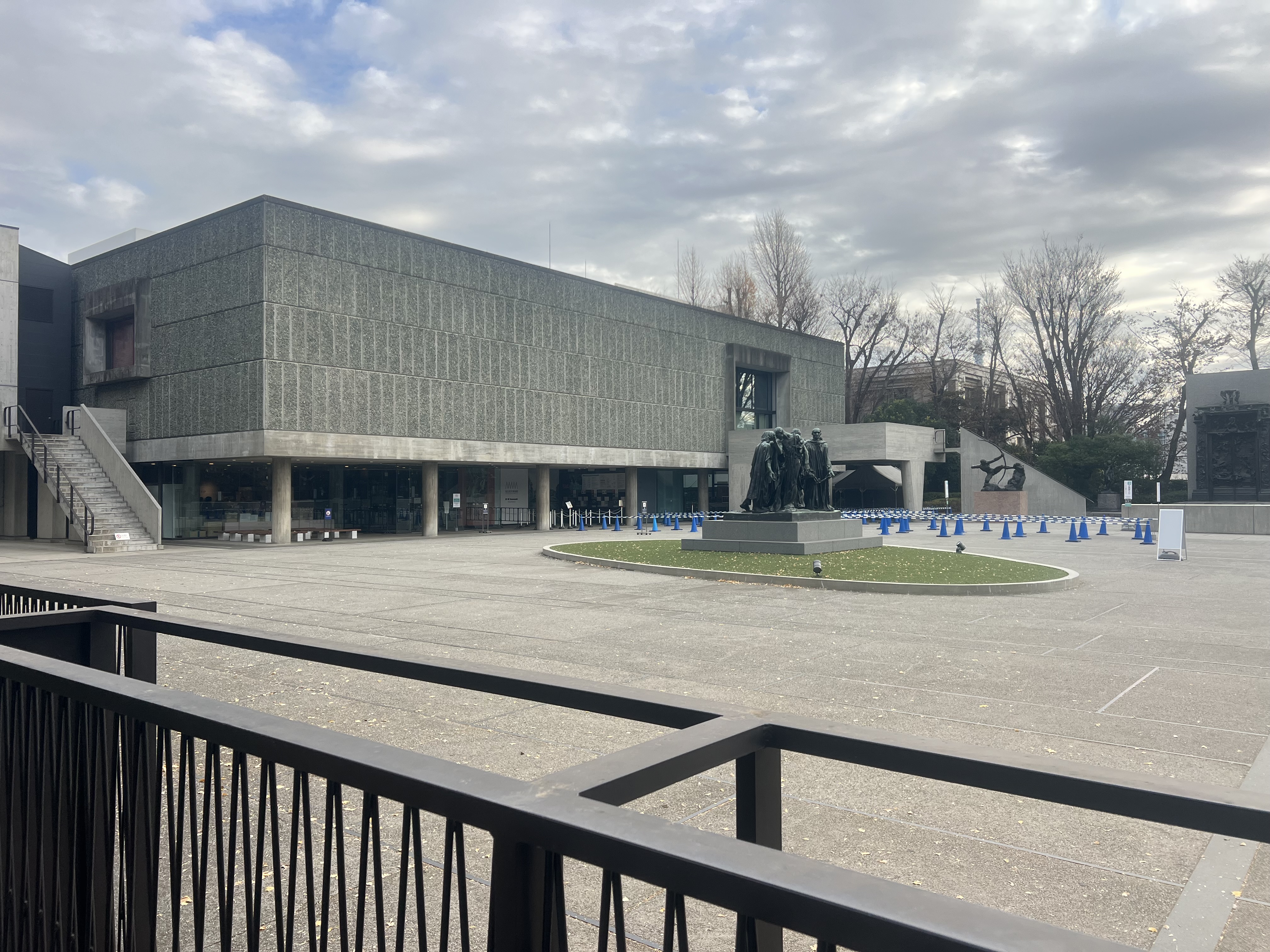
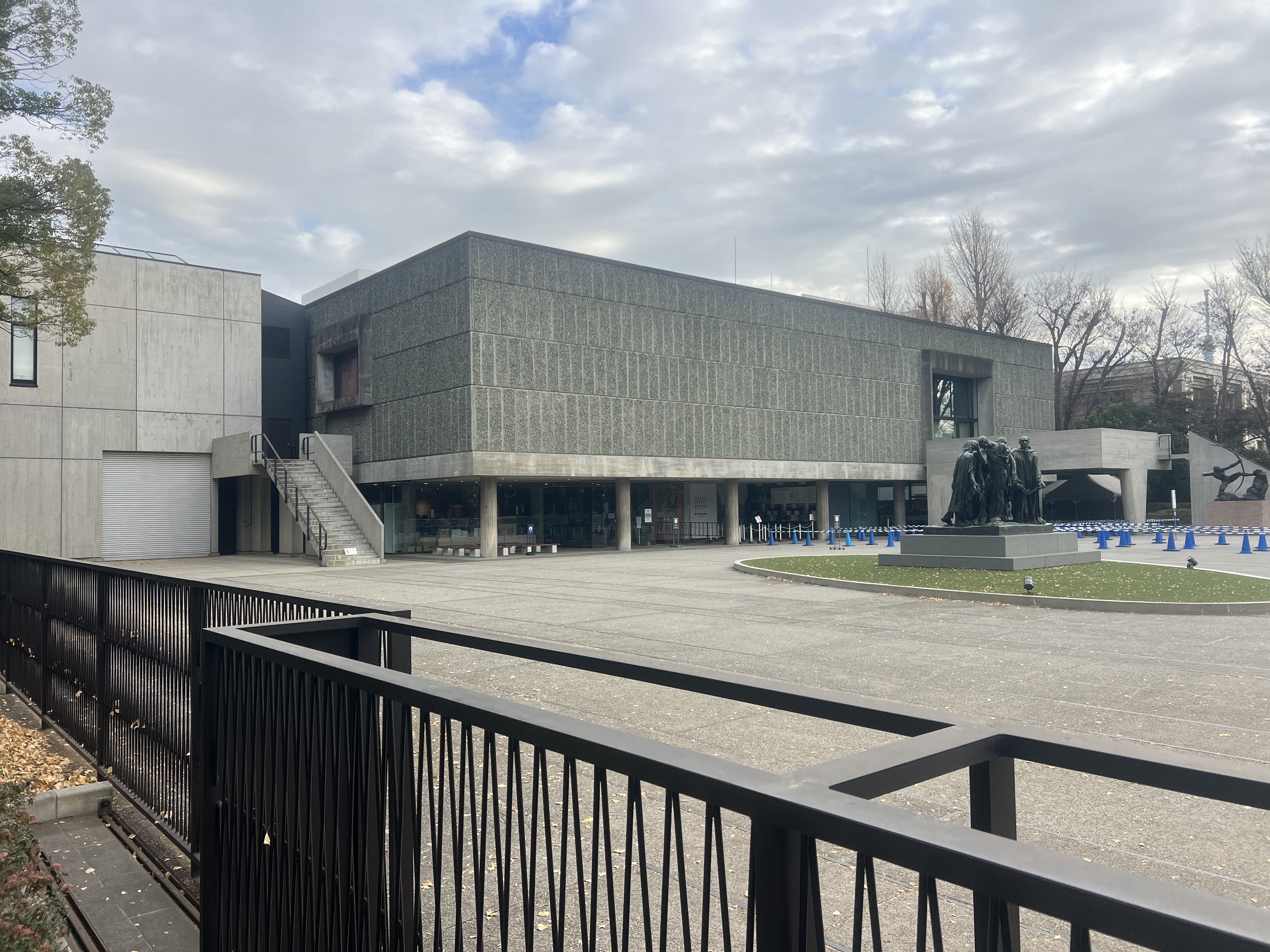
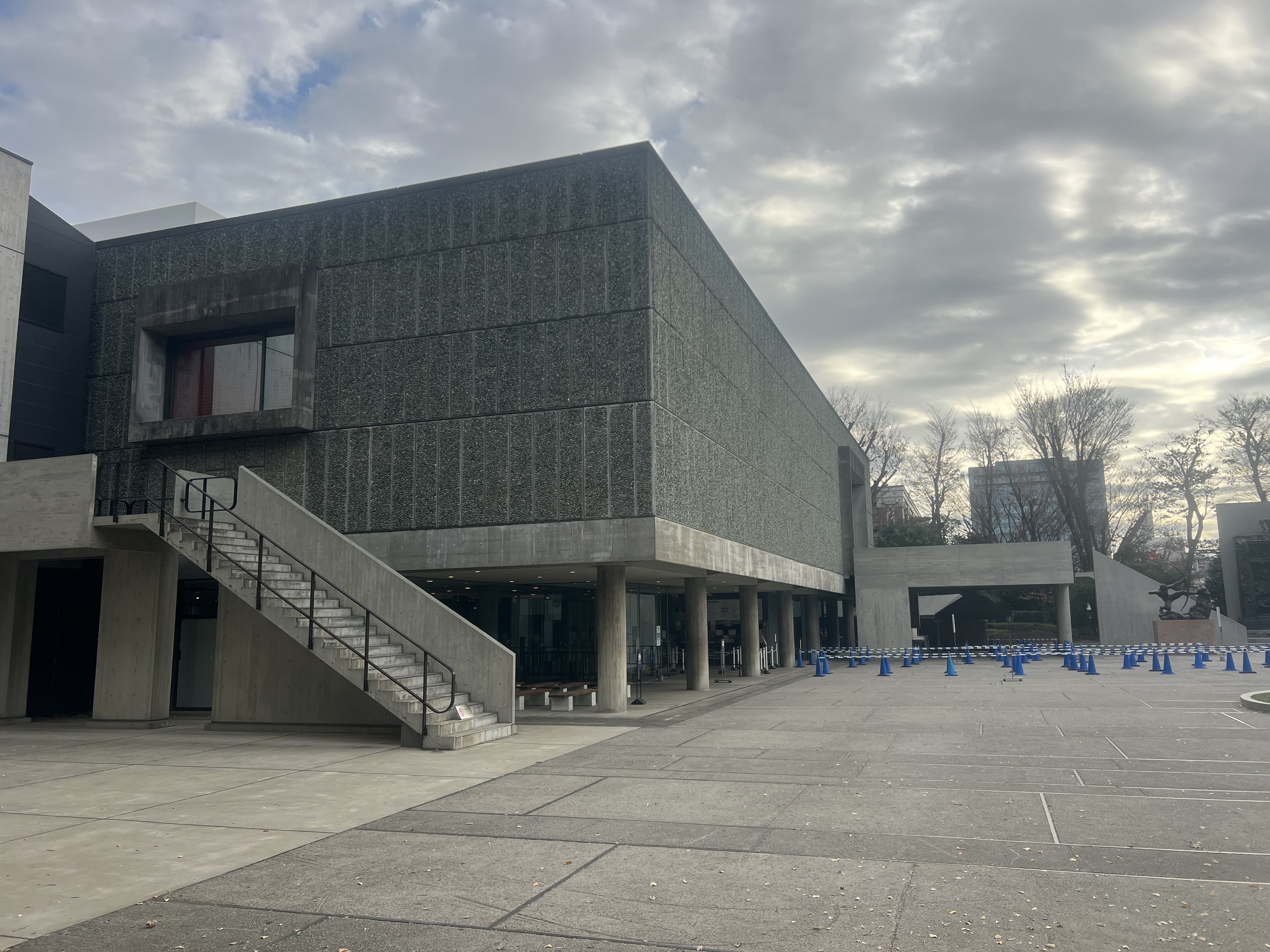
In Decemeber 2025, I travelled to Japan. It was a fairly quick trip and a decision I feel really good about for a number of reasons– I am happy I went, to the utmost. However, there was one building that I saw and am thinking of now, I took a dozen photos of it, but did not go inside, to my current chagrin. Here is why.
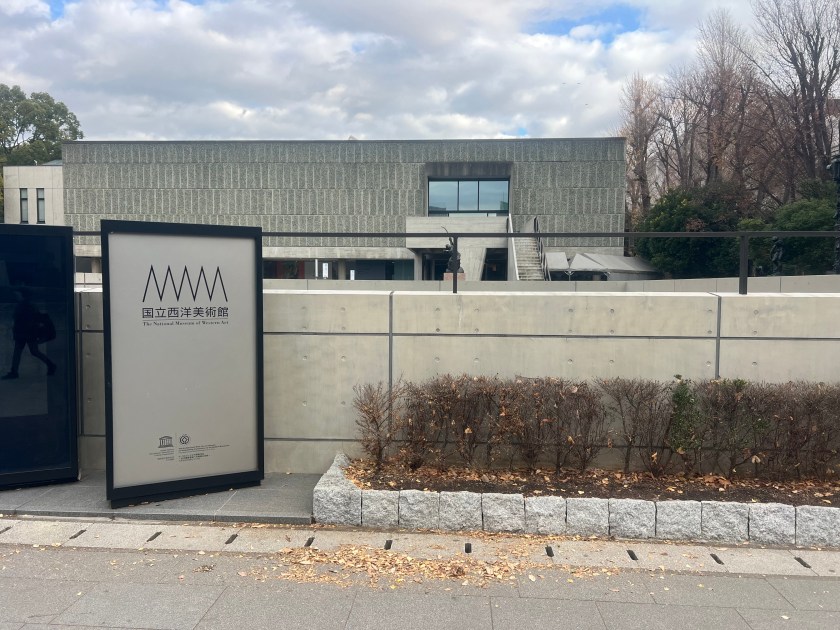
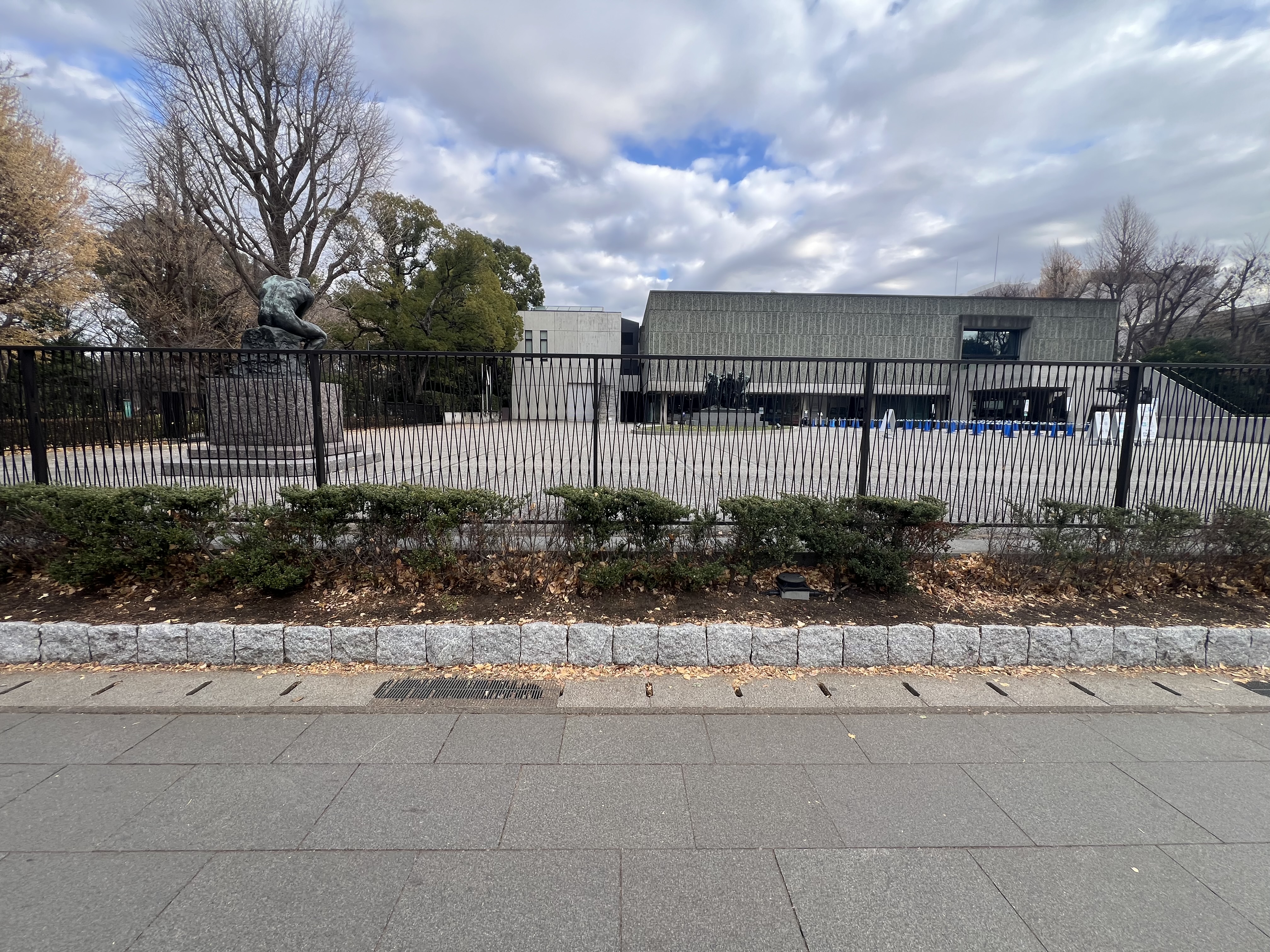
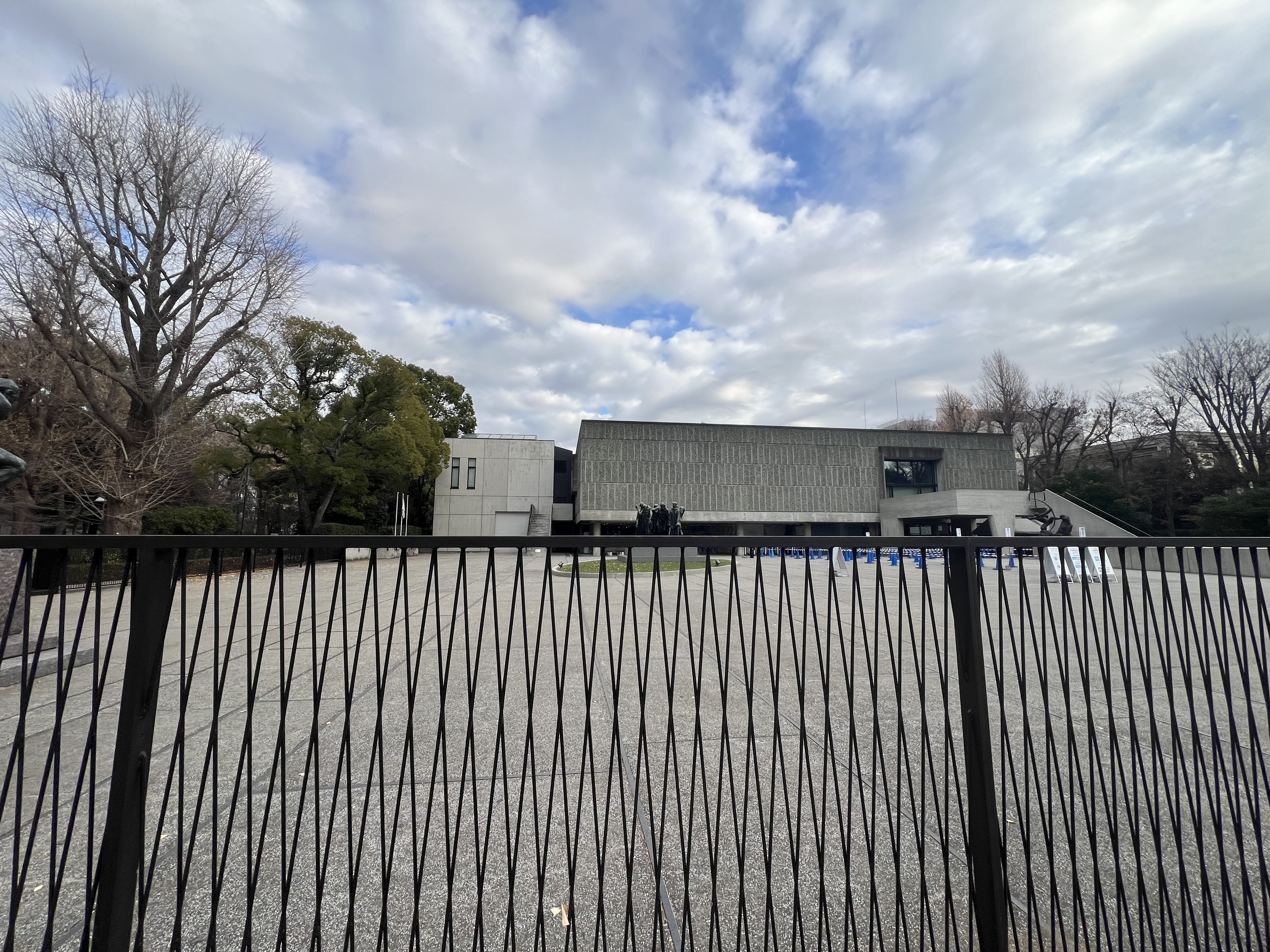
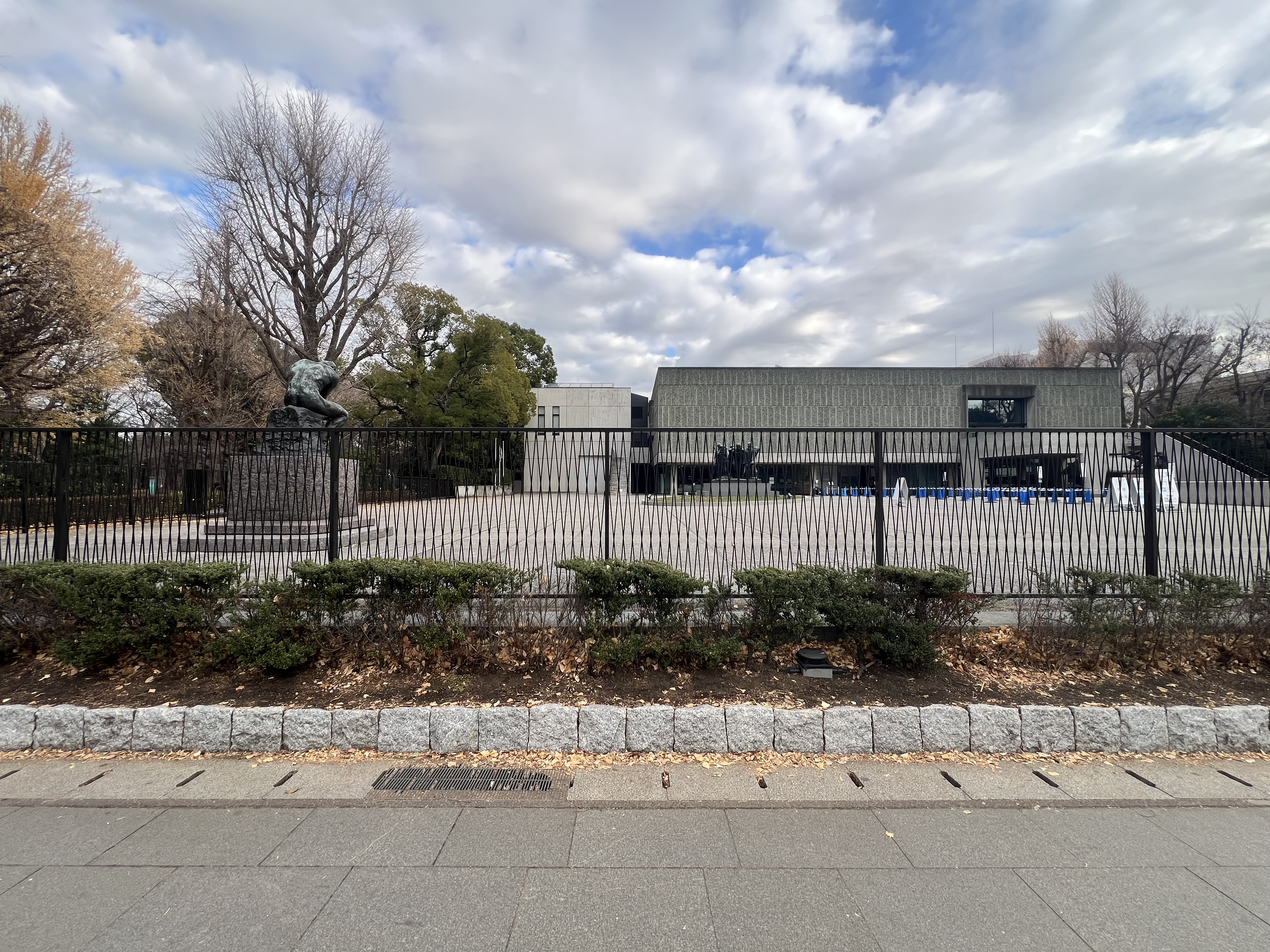
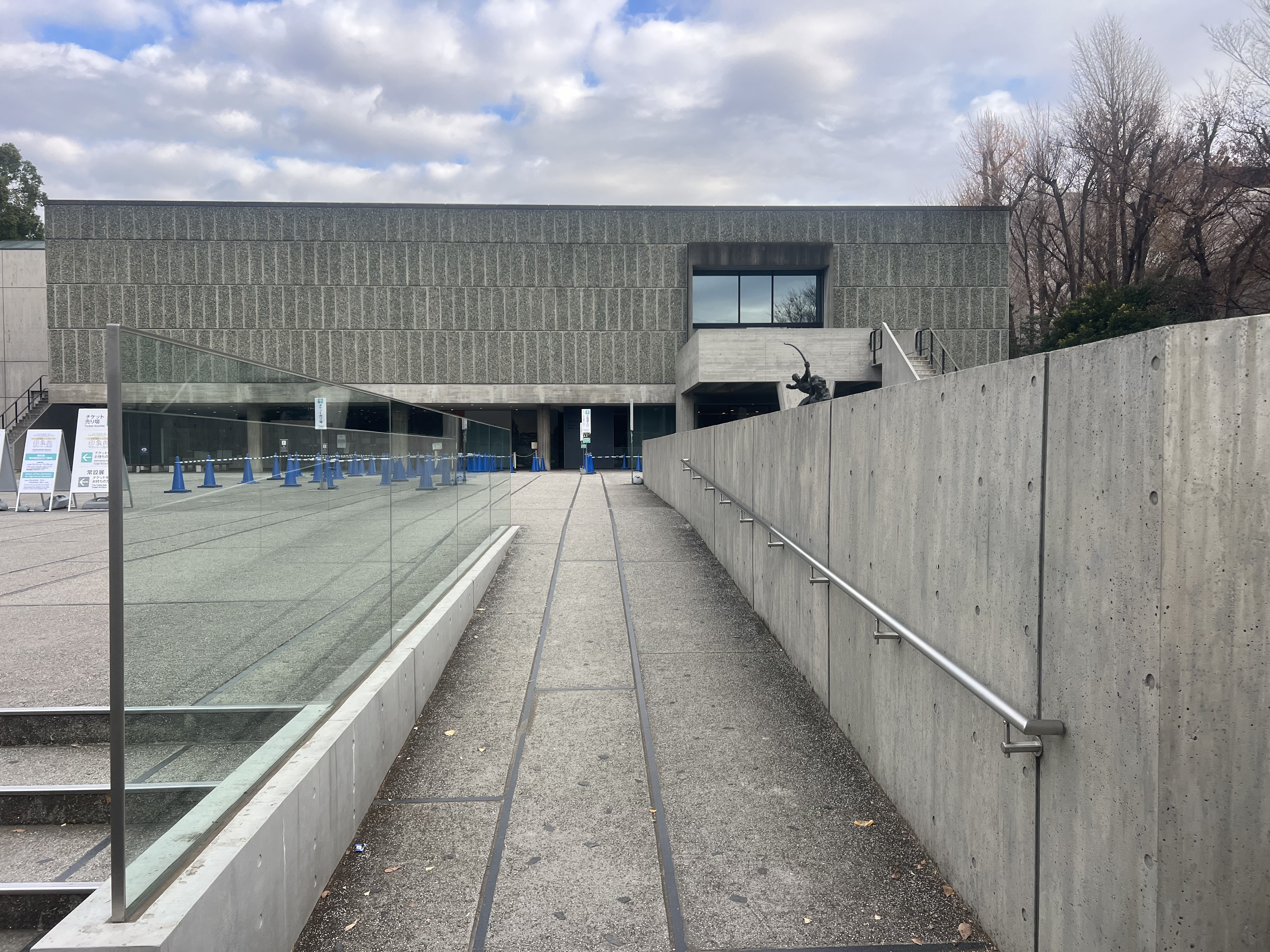
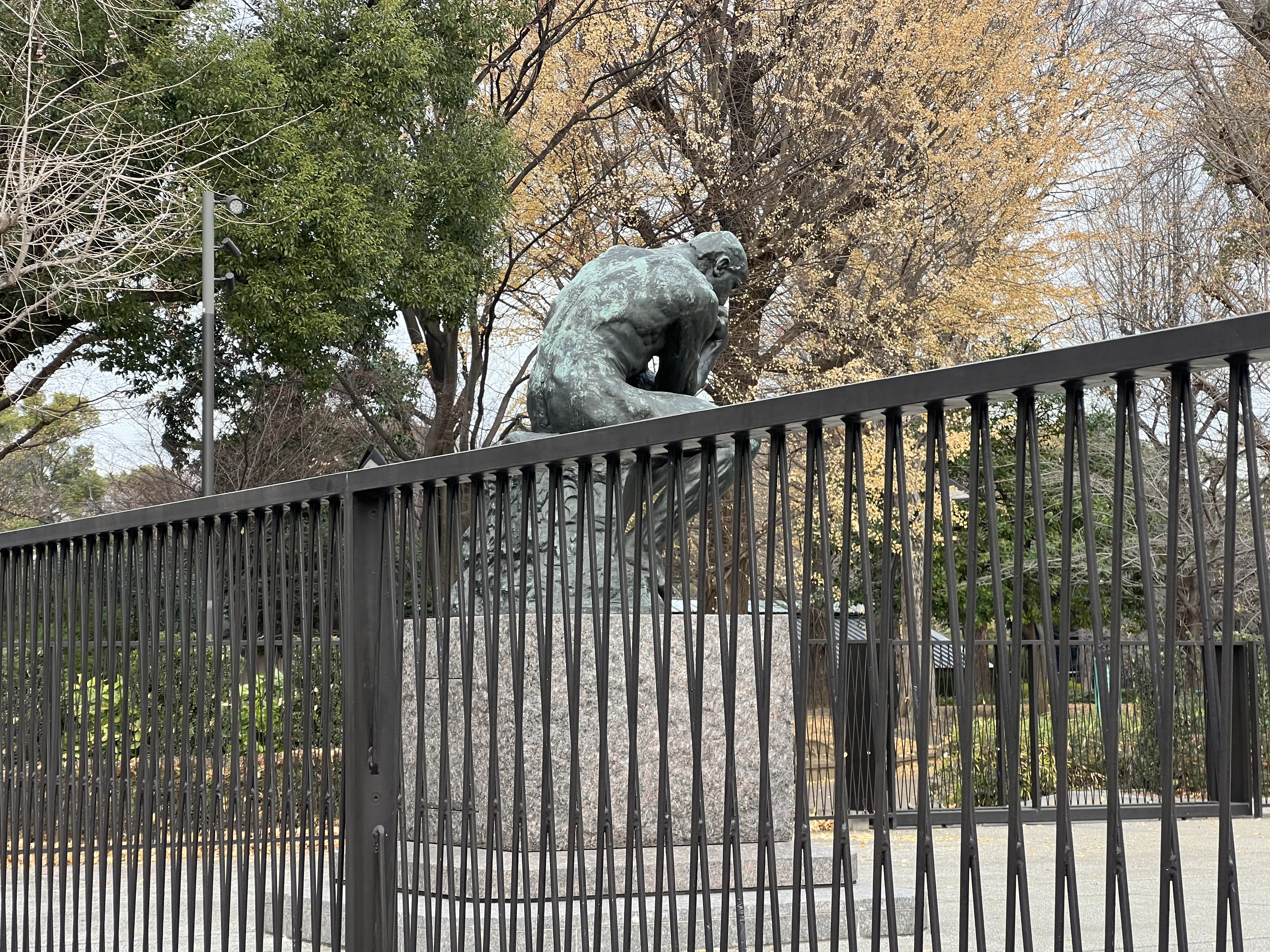
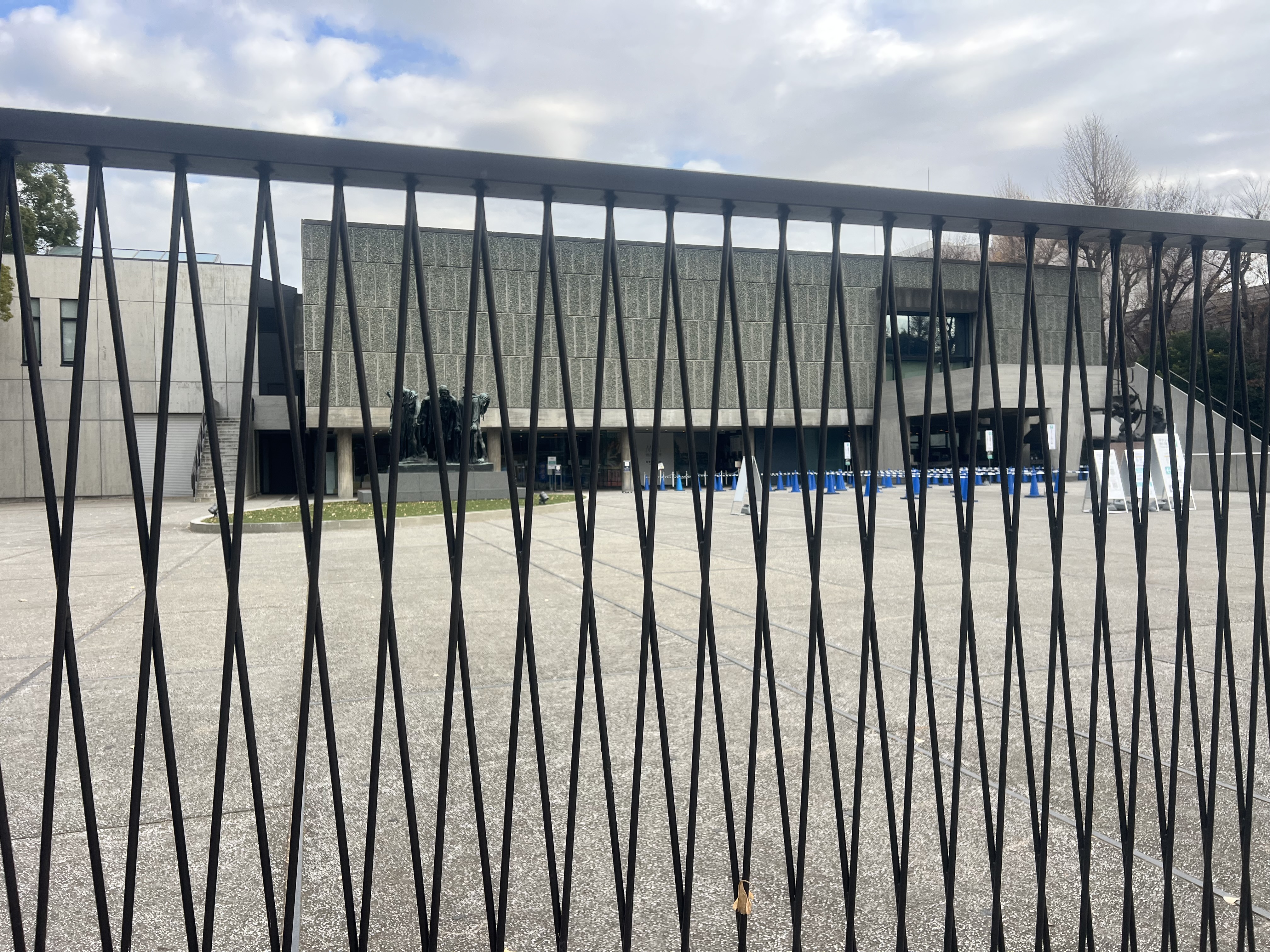
While in Tokyo, I am thinking back now about what I saw, while there I waited by a museum early one morning in Ueno Park. I was up and out early, waiting for a Museum of Nature and Science, and the Tokyo National Museum to open, but there was this other one that caught my eye. It is the Museum of Western Art. I was not travelling in Japan to learn about the West, obviously, but sometimes that is what happens. You can learn about one culture by visiting another culture, at times. But I was struck by the modern concrete brutalism of this museum and the statuary in the entryway were clearly by Rodin: The Thinker, Burghers of Calais and the Gates of Hell were recognizable. These are hard to miss, and actually overshadowed the building by Corbusier that they adorned.
What I am doing my best to share with you most right now is, I happened to stand outside, my second Le Corbusier building and did not know it at the time. My first was the Carpenter Center for the Visual Arts at Harvard, in Cambridge, Mass. That is his only building in the United States, and the Museum of Western Art in question is his only building in Japan.
Le Corbusier was instilled in my imagination in college. Early on in architecture school in the 1990s, one of my professors was from India and his father worked directly with Le Corbusier on his buildings there. This prof wrote books about Le Corbusier and taught us a lot about his work. Very memorable, and the work stands out among all in the 20th century. I would admit now, that Le Corbusier was my first favorite architect, and I know most of his work well from readings, but somehow, I missed this one’s attribution to him, and will regret not going inside. Until my next trip to Tokyo.
I am thinking now about studying the Museum of Western Art’s plans and walkthroughs, as the Carpenter Center for the Visual Arts was very experiential and about movement and circulation, I have a hunch this one is concerned with that too, but right now, I do not learn more about what I missed out on and do not want to deepen my chagrin.
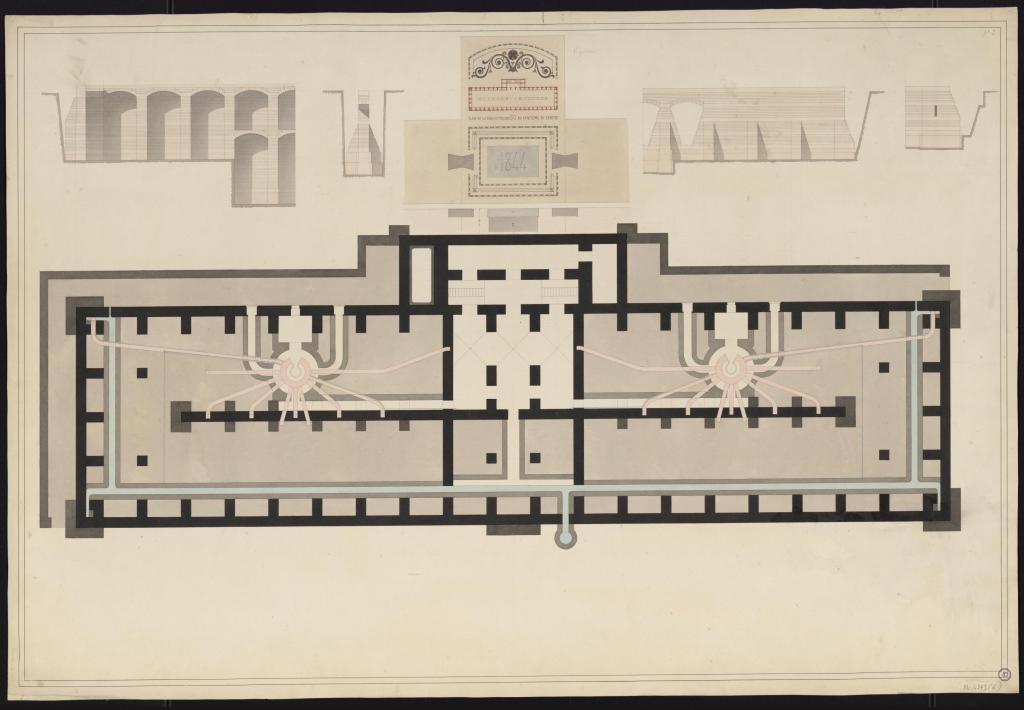
Hello, I was browsing some architectural books and files, as I am known to do. I stumbled upon this.
I have two questions for you concerning this image. The first is a warm up, the answer to which I know and you should too. The second is the one I really want the answer to, so if anyone knows, please inform me at your convenience.
QUESTION 1: the building depicted in the plan is the:
A) BNF,
B) BSG,
C) BHVP,
D) BIS
QUESTION 2: the unusual feature with many arms in the plan is the:
[This is a first draft–work in progress– updated 5/11/2026]
After a long morning of browsing all genres at the bookstore the other day, I wound up buying a paperback copy of Machiavelli’s “The Prince” on an impulse. After reading and beginning this essay, I thought to myself how I could devote the rest of my life to reading and reviewing literature for its architectural implications. Not sure if that is a good idea but it is entirely possible.
Concerning Machiavelli, I had a lot of preexisting thoughts about him and his work for some reason, more about philosophies of politics and power and less about architecture as I had previously understood it. But why would architecture not be about politics and power? Why should my privately formulated views of how things should be override the predominance of the outside world and how they are, even if they should not be.
Machiavelli wrote in the historical years at the heart of the Italian Renaissance. He was more concerned with the “Art of War” and was a humanist even though he described some of the more unfortunate human tendencies. I know I associate Renaissance architecture with museums and religious facilities, mostly, but the culture’s production spanned the gamut of program.
In “The Prince”, the term “architecture” is not invoked directly. Though the author directly questions the use or uselessness of its most architectural example, the fortress. Throughout, the book there is a logic of order and disorder, which I think of as a kind of architectural idea, some mentions of foundations, some discussion of cities, and some ideas about fortifications. The personalities involved, in “The Prince” Machiavelli’s hypothetical princes, whether they are principled or not, are completely memorable and do seem inflected in an architect kind of way. Maybe seeing Machiavelli as an architectural mind, sure if that is associated with ego, he could be considered.
Overall implications for architecture and urbanism of the Princeare full of animosity and militarism– sounding more destructive than constructive. Cities are either ruled or acquired or conquered, however unpleasant any of these scenarios. I expect much of the same in Machiavelli’s Art of War as well. This is something worth considering even for the peaceful mind. Cities, towns, settlements, communes, any populated area are frequently termed “principalities” in the book to reinforce their princely rule. One cynical line stood out: “a city used to freedom can be more easily ruled through its own citizens, provided you do not wish to destroy it, than in any other way. ” (Machiavelli, p.21)
The chapter “Constitutional Principalities” characterizes cities as such, “two different dispositions are found in every city: and the people are everywhere anxious not to be dominated or oppressed by the nobles, and the nobles are out to dominate and oppress the people. These opposed ambitions bring about one of three results a principality, a free city, or anarchy” (Machiavelli, p.41). Unfortunately whole populations of cities are at risk of domination or oppression by these misguided rulers, and Machiavelli sees this as unavoidable. Nobility should not behave this way or they cease to be noble, any kind of oppression runs contrary to what is suggested in their name.
Further along, Machiavelli discusses “foundations of any state” which he decides are “good laws and good arms”– again resorting to arguments for belligerence included along the way. Apparently, foundations have long been useful in supporting buildings but are also as enduring as a supporting literary device. Another rhetorical architecture (or civil engineering) metaphor are the resistances to fortune: “So it is with fortune. She shows her potency when there is no well-regulated power to resist her, and her impetus is felt where she knows there are no embankments and dykes to restrain her.” (p.105-106). Throughout “The Prince” fortune annoys the author, as a kind of random chance influence, that Machiavelli wants to prevent.
Fortresses in their efforts at impenetrability, can be used keep the outside out or the inside in. Depending on the powers that be, a fortress might function as a castle to defend against marauders or as a prison to keep individuals from getting the public world. In defense, an example of Countess of Forli is given, where she takes refuge in a fortress (Castle of Sant’Angelo?) occupying it until the offensive subsided.
Machiavelli noted the “independence” of German cities on p.46, and their “excellent moats and walls” obviously aware of parallel ideas in northern Europe, seeming a little competitive, or envious. Polymath artist Albrecht Durer was also interested in fortifications at the time, wrote a whole treatise on the topic (see illustration).
Machiavelli maintains militarism throughout the book, insisting that a ruler should only think and know “the art of war”, I wonder is he being serious or facetious? So cynical. He suggests suppressing imagination of “dreamed up republics or principalities” for “real truth” which can only be inflected by his combative, and competitive disposition. He is aware that extreme and harsh rulers are at risk of “losing their state” (Machiavelli p.65-66), advocates for some degree of parsimony and some degree of generosity.
In closing, I am unsure of the sincerity in “The Prince”. The author must be indulging in hyperbole. Their reasoning and justification for bad leadership cannot be genuinely made in good faith.
My main takeaway in all this fortification and walling away of towns and cities is that it all hinges on the ruler or noble or prince as they may be “not being hated”. In one elaboration, “[Machiavelli] censure[s] anyone who putting his trust in fortresses, does not mind if he is hated by the people.” (p.94). Popular opinion is much more powerful and Machiavelli recognizes that no matter how the prince “makes a town into a bastion” they can still lose their state and power by low approval.
NOTES
As time passed and the Renaissance ran its course, the pointed polygonal approach continued through the centuries. Here is a geometrical analysis of many more star fort examples. https://www.nature.com/articles/s40494-025-01632-y
The translation of Machiavelli’s “The Prince” that I read was translated by George Bull and was published by Penguin Books, Great Ideas.
In my experience, in the decades from 80-00, it was not hard to find architecture that was theoretical and intellectual. 00-10 years grew out of that climate, of course and then grew into what we have now. There was a strain of intellectualism in those 80-00 years that held my attention through 00-10 to this day. How to characterize the work of the majority since? it is certainly manifold but I have focused on pragmatics, clung to that. Perhaps the majority was pragmatic all along, and that is likely. What I saw as good work in those early 80-00 days was significantly more daring and adventurous than I have aligned with since. Trying to go back to what appealed to me early on, when I got started. Two key concepts I kept with me from those days: Theater and Theory.
Good architecture, not even the best architecture, but just good architecture is ineffable. Maybe architecture of any kind is ineffable. We should just enjoy it. Do not overthink it. Enjoy when you think you find it.
[stop here if you are averse to argumentation]
OR
[click here for a few opinionated paragraphs]
Okay, so here I would like to suggest, along those lines, that architecture is not easy to fairly describe, that furthermore, architecture cannot be ordered or ranked or filed adequately, in any way. At least I have not seen such a way, beyond opinion. These may get pretty elaborate but they are what they are. Honestly, I limit myself pretty strictly and do not easily call buildings “architecture” at all, let alone try to prioritize or numerically order them.
It bugs me, then, when a question such as this highlighted one, or similar, is posed or implied, “who is the world’s best architect?” when a best American architect, between the choices of Frank Lloyd Wright, or Louis Henry Sullivan, slips and falls from some ranking schema into an easily debatable opinion.
If you do not know who Sullivan is, ask me sometime, I can help.
I mean there are whole books framed to make you think of how highly ranked Frank Lloyd Wright is in the pyramid of architects or whatever the hierarchy may be, such as Frank Lloyd Wright “America’s Greatest Architect” (Herbert Austin Jacobs, 1965) . And an infamously brazen story of a lawsuit where Wright testified under oath that he was “the World’s Greatest Architect”. Nowadays licensed architects must avoid advertisements or claims that place them above the norms and tendencies of other licensed architects, which is called the ‘Standard of Care”.
I have studied Wright and his work for years, I honestly like his work. I appreciate the shelves upon shelves of Wright scholarship, I too have written about his work, gone inside, drawn it, discussed–and am still not sure what his claim to fame is, except for indulging in so much fame, his buildings are good but seem secondary to his attention seeking.
Back to the question in bright yellow, now. I would suggest here that Wright was not even the best in his office, when he worked for Adler and Sullivan. The principals were both better (I have began listing why in another post for later).
Wright was not the best in Chicago. He might have been maybe pretty good in 1910s Spring Green, Wisconsin or in 1930s Scottsdale, Arizona–if there was such a thing. Towards the later half of his life when superlatives about his career swirled and were invoked, many of his own proteges and apprentices were more talented and capable in the 1920-50s. They did the work he was credited with. Wright was frankly too old.
Either way, enjoy this “step well” “light well” I drew a few years ago.
If you do not know this form of architecture, ask me or ask around.
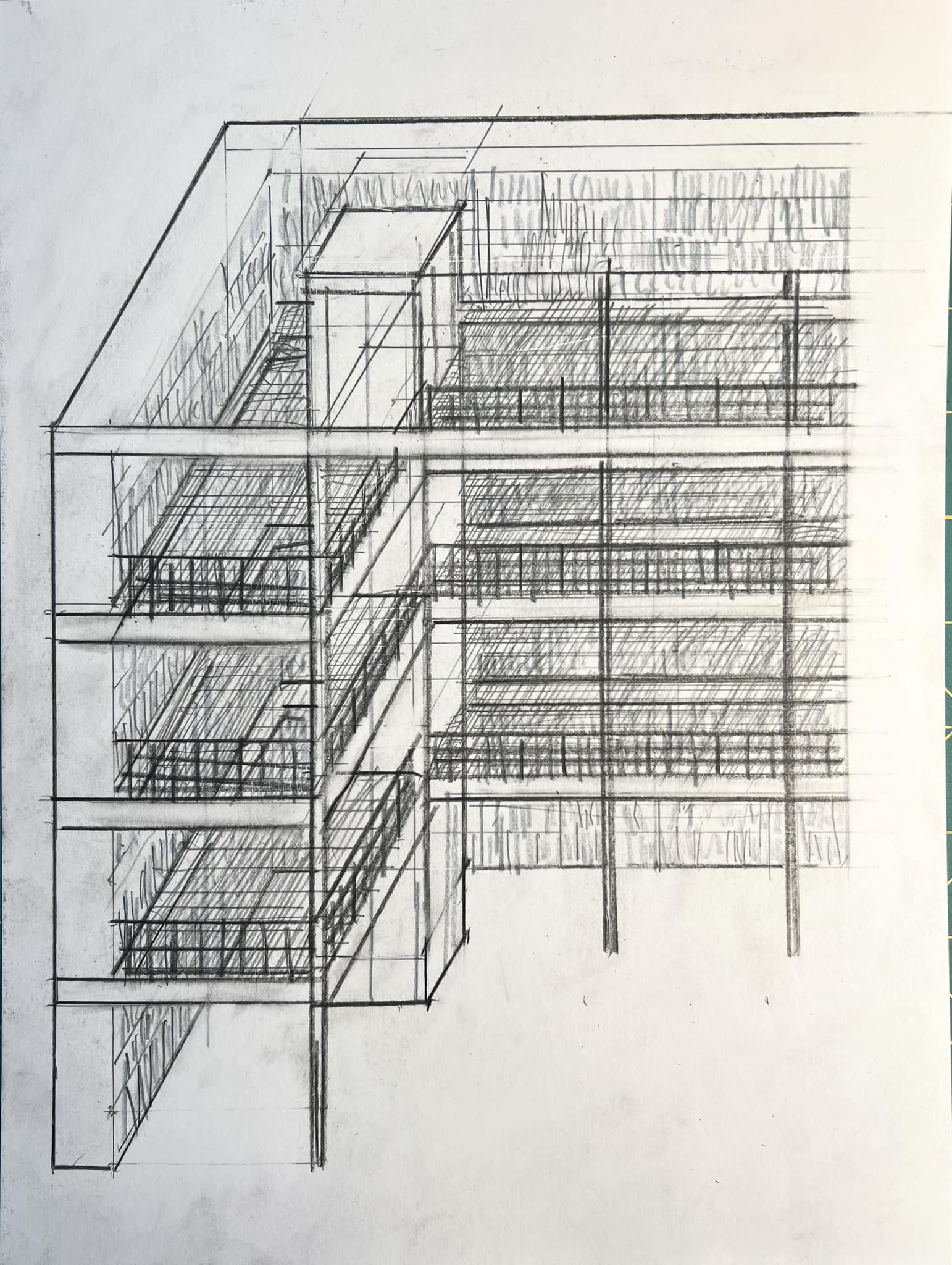
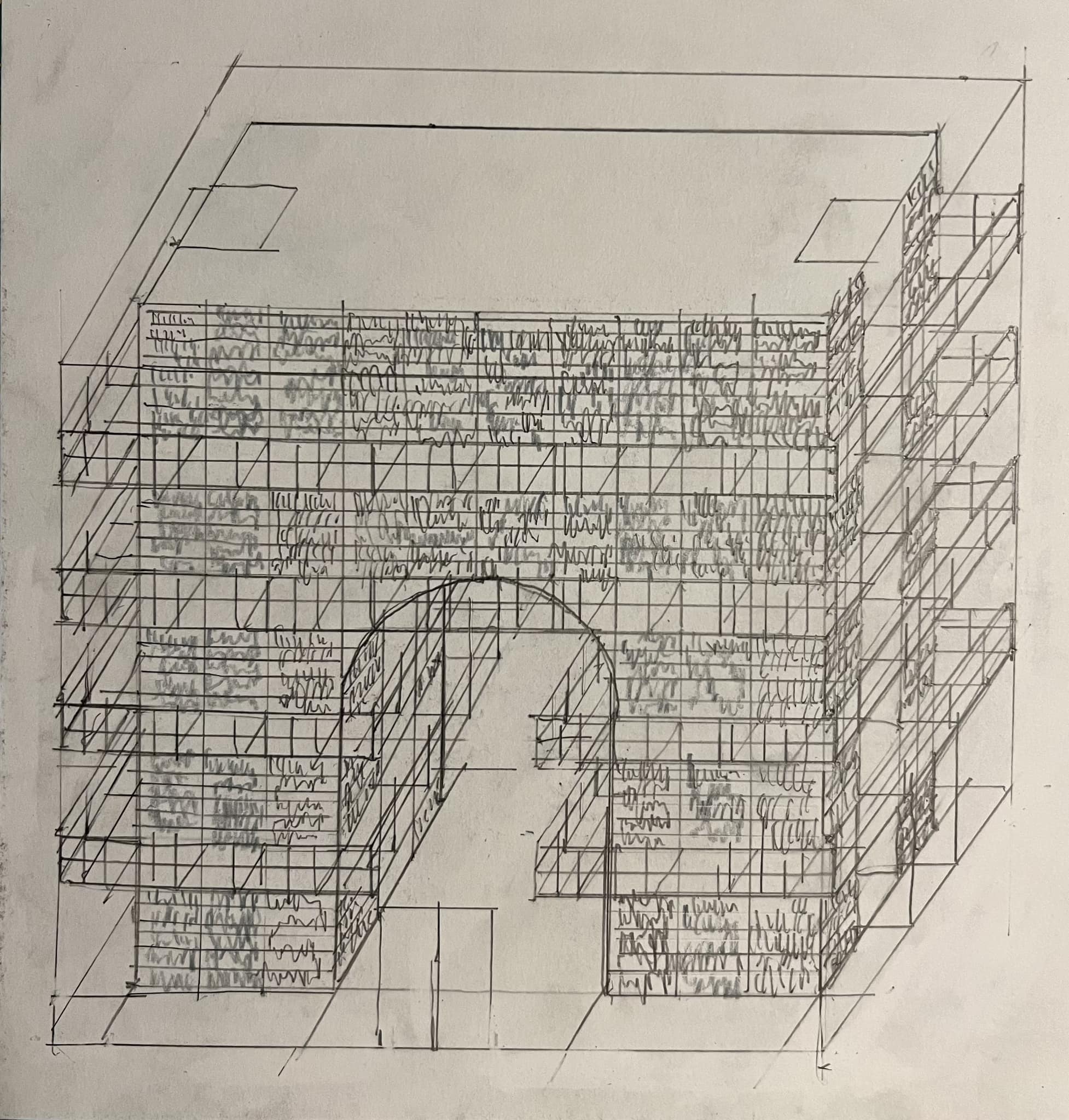
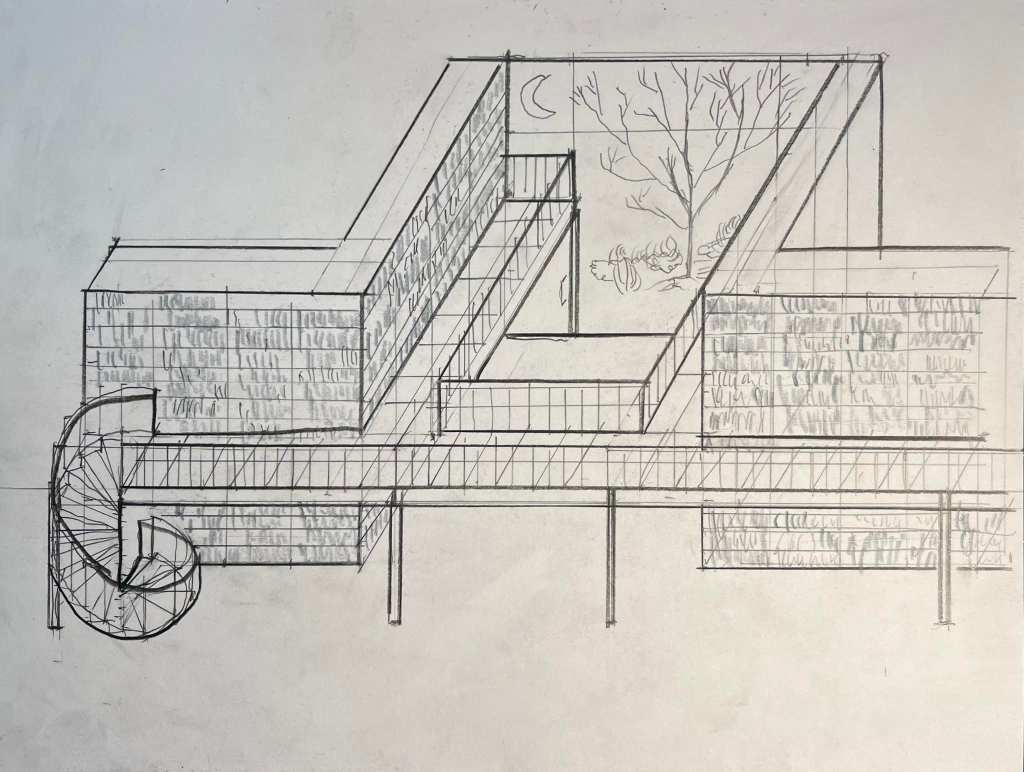
I have a few things to share this week which I found out was National Library Week. Honestly I did not know that there was such a thing, because every week is Library Week for me. Apparently it has been celebrated for 60 years!
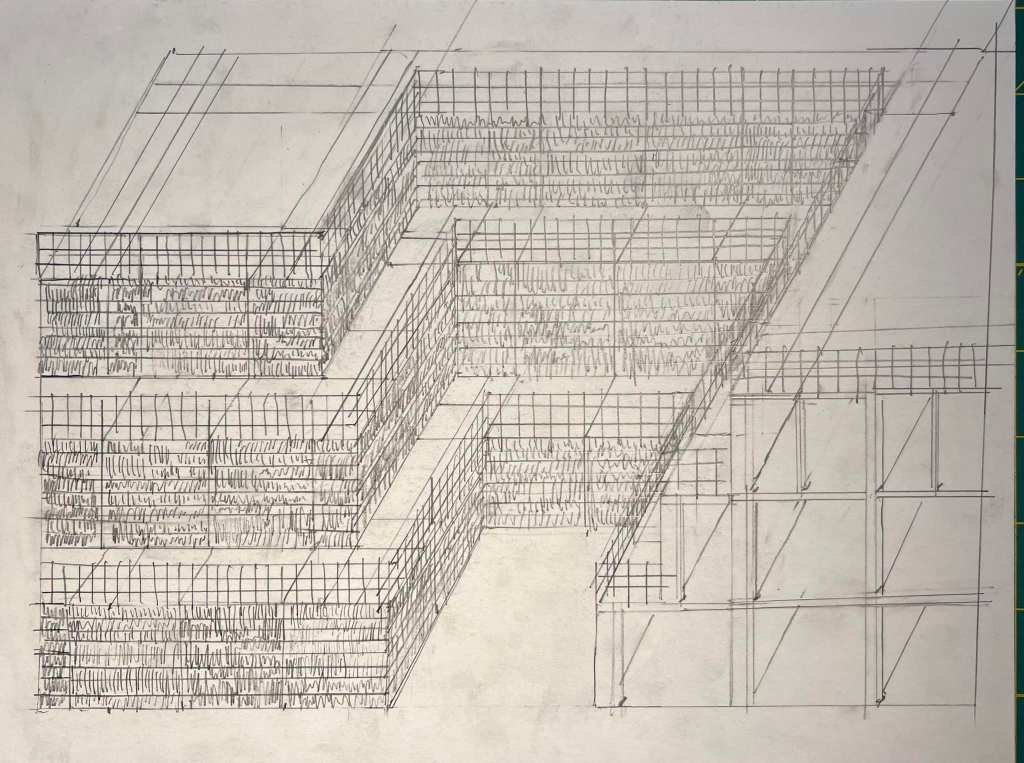
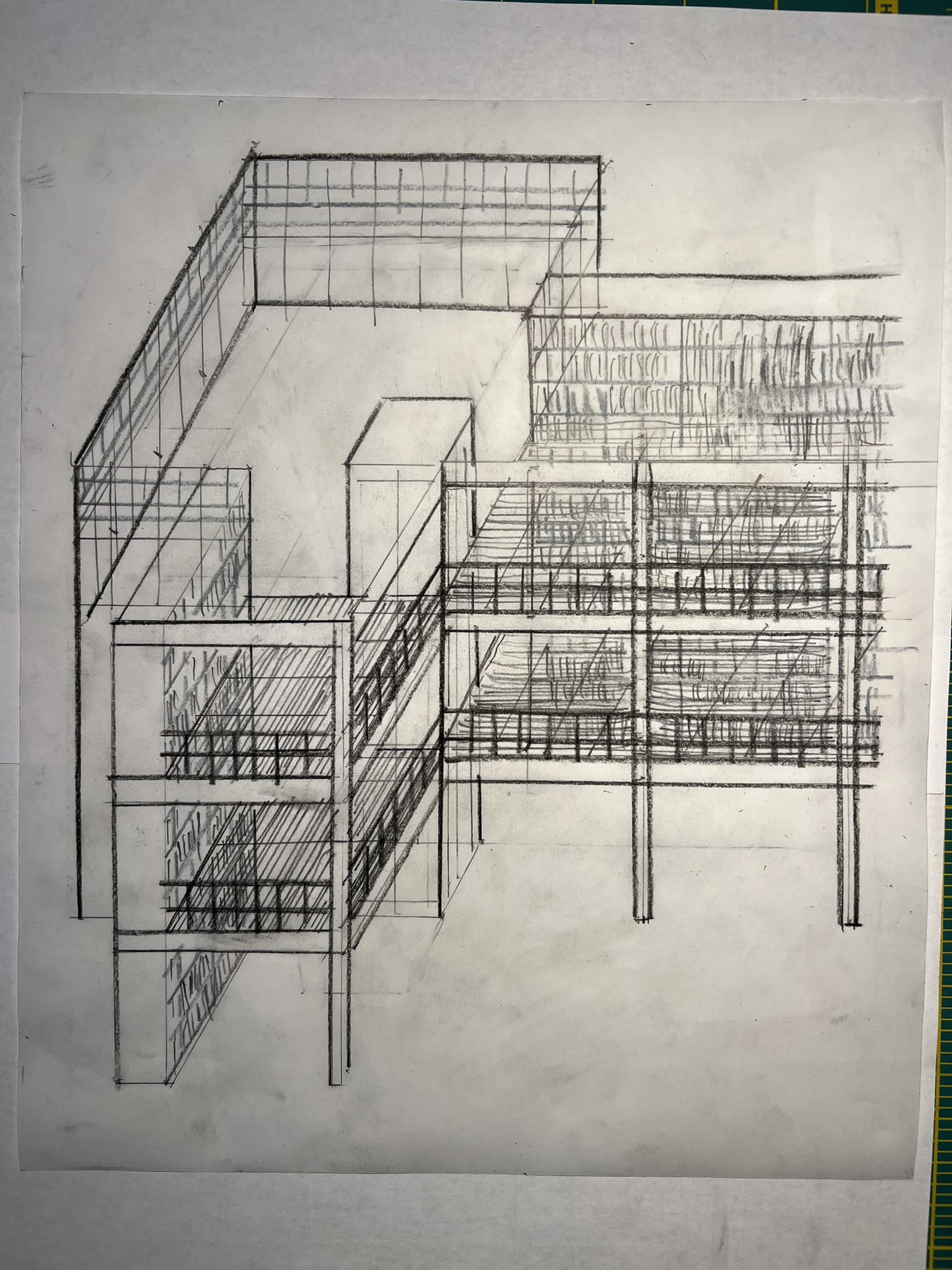
What I would like to share are some designs. First is a multifloor library design, hand drawn in 2024.
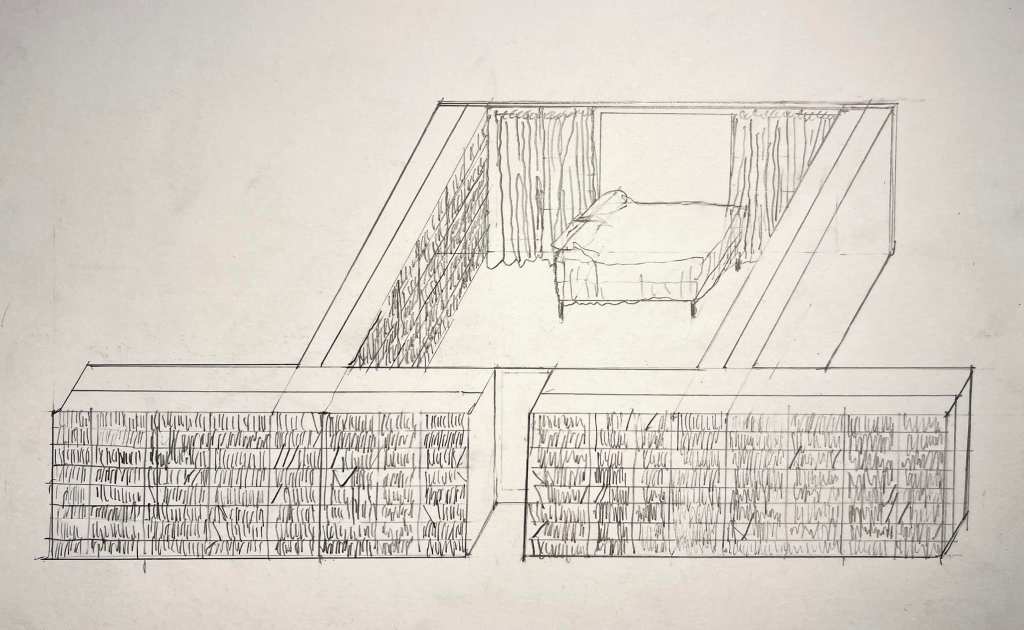
Second I would like to share this home design, from the same sequence in 2024.
I love the feeling of being around a lot of books, I like reading but I like the mass and gravity of books.
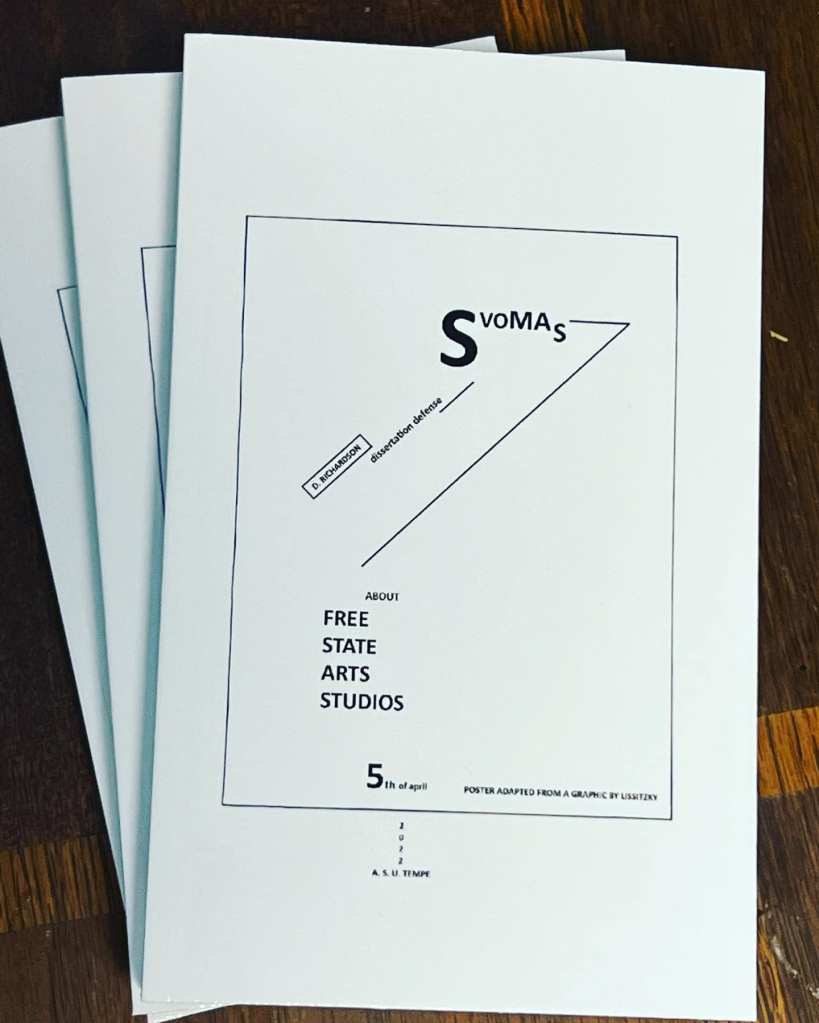
While I am on the topic of books, here is my own book, my dissertation.
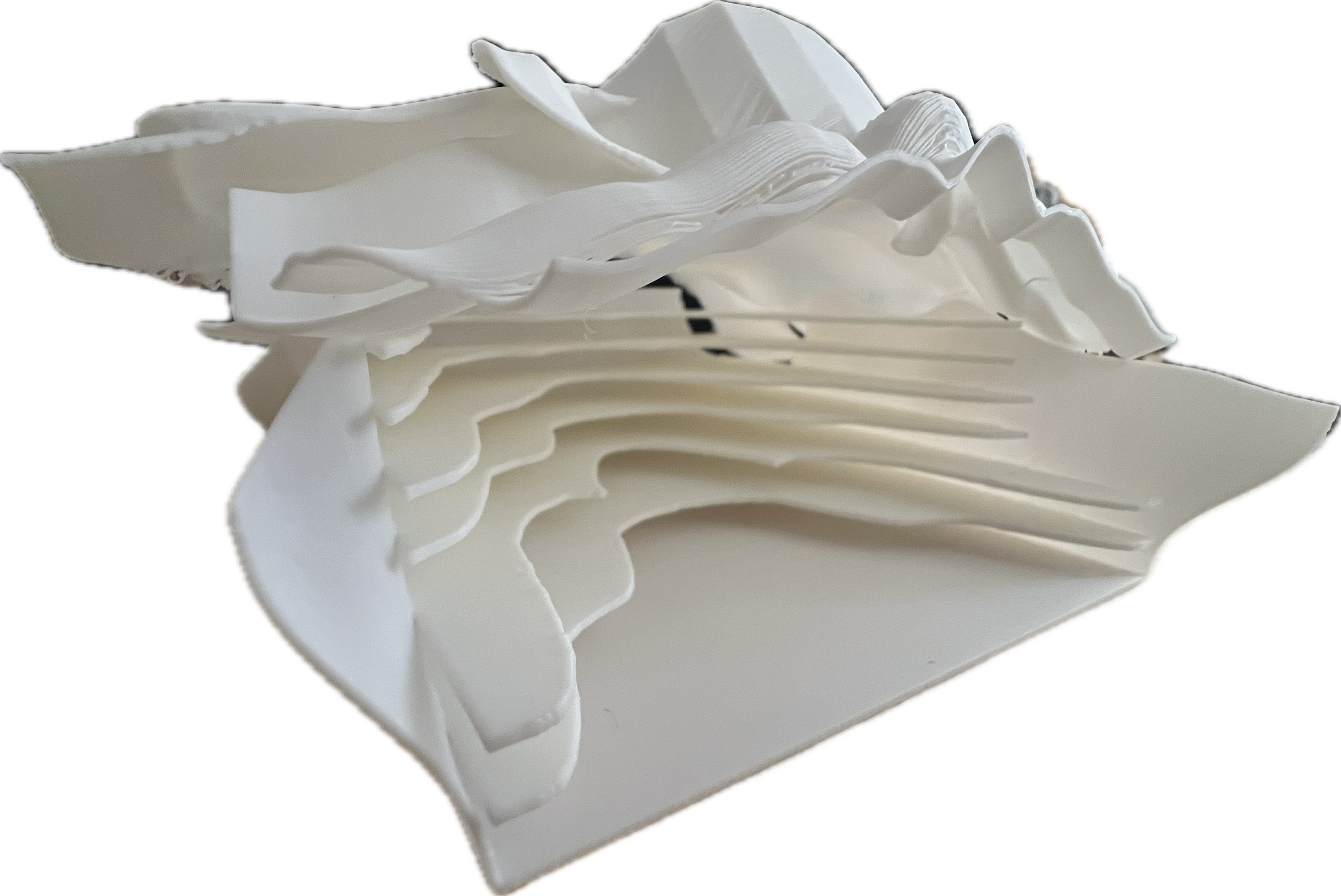
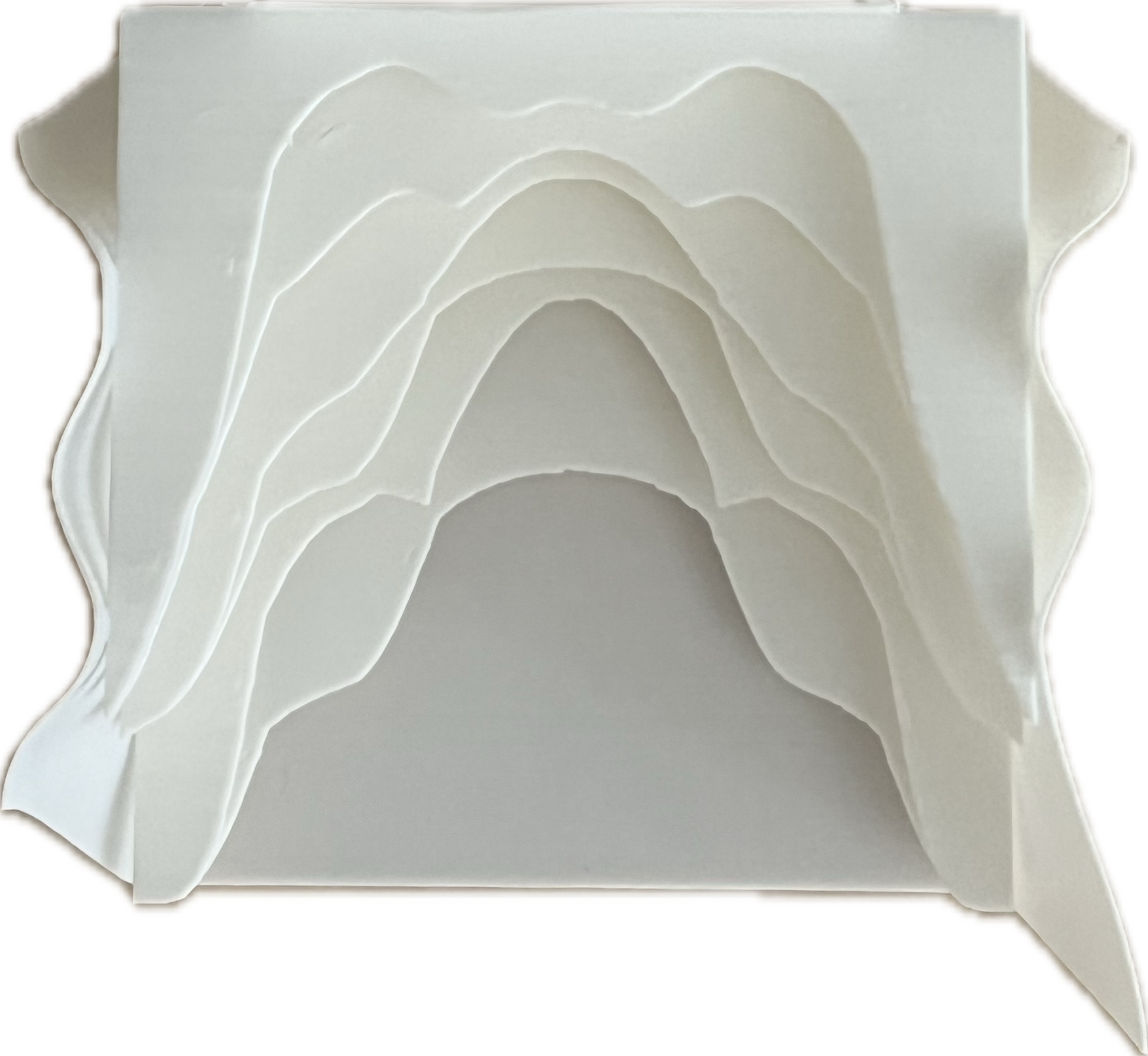
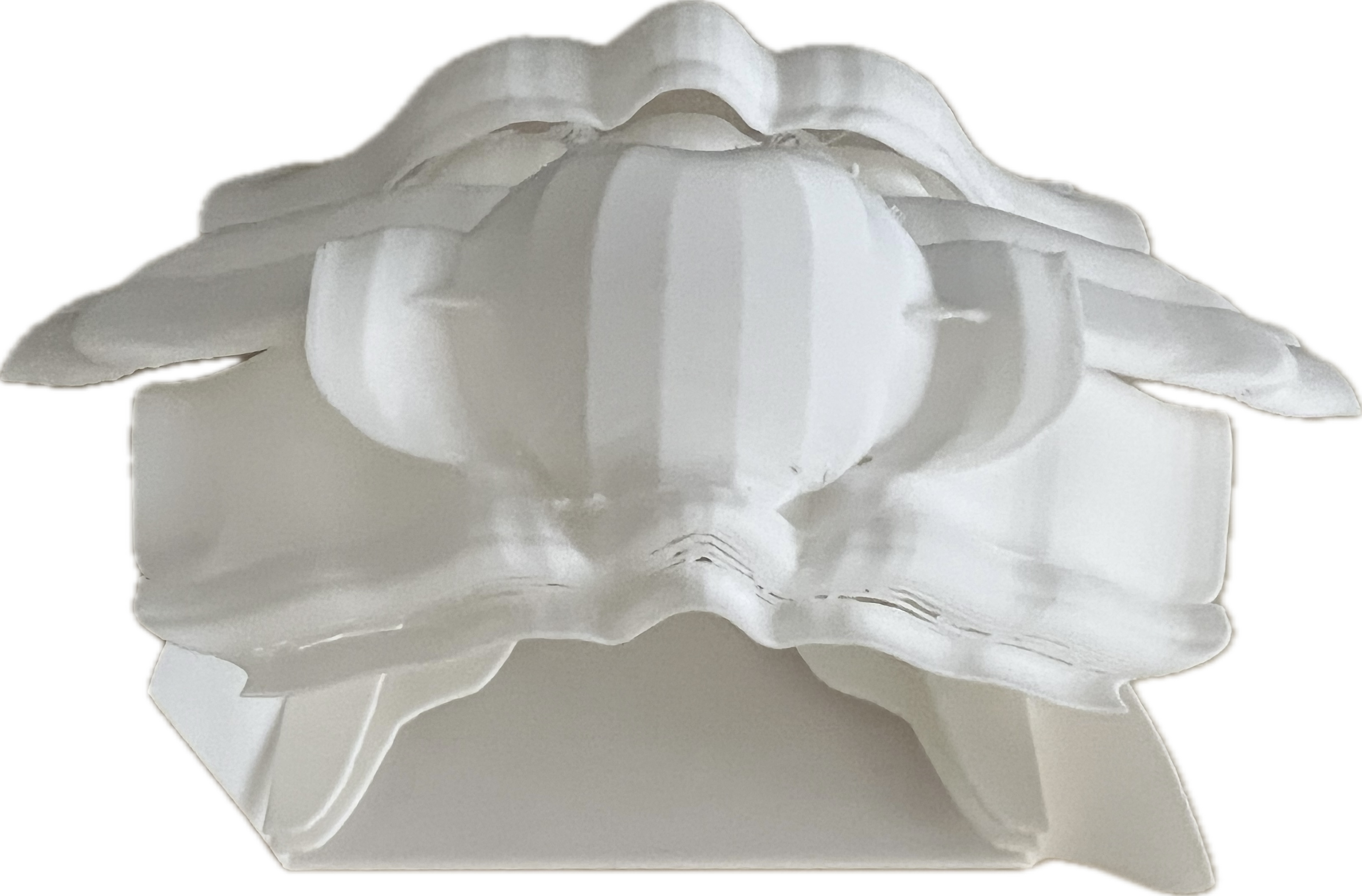
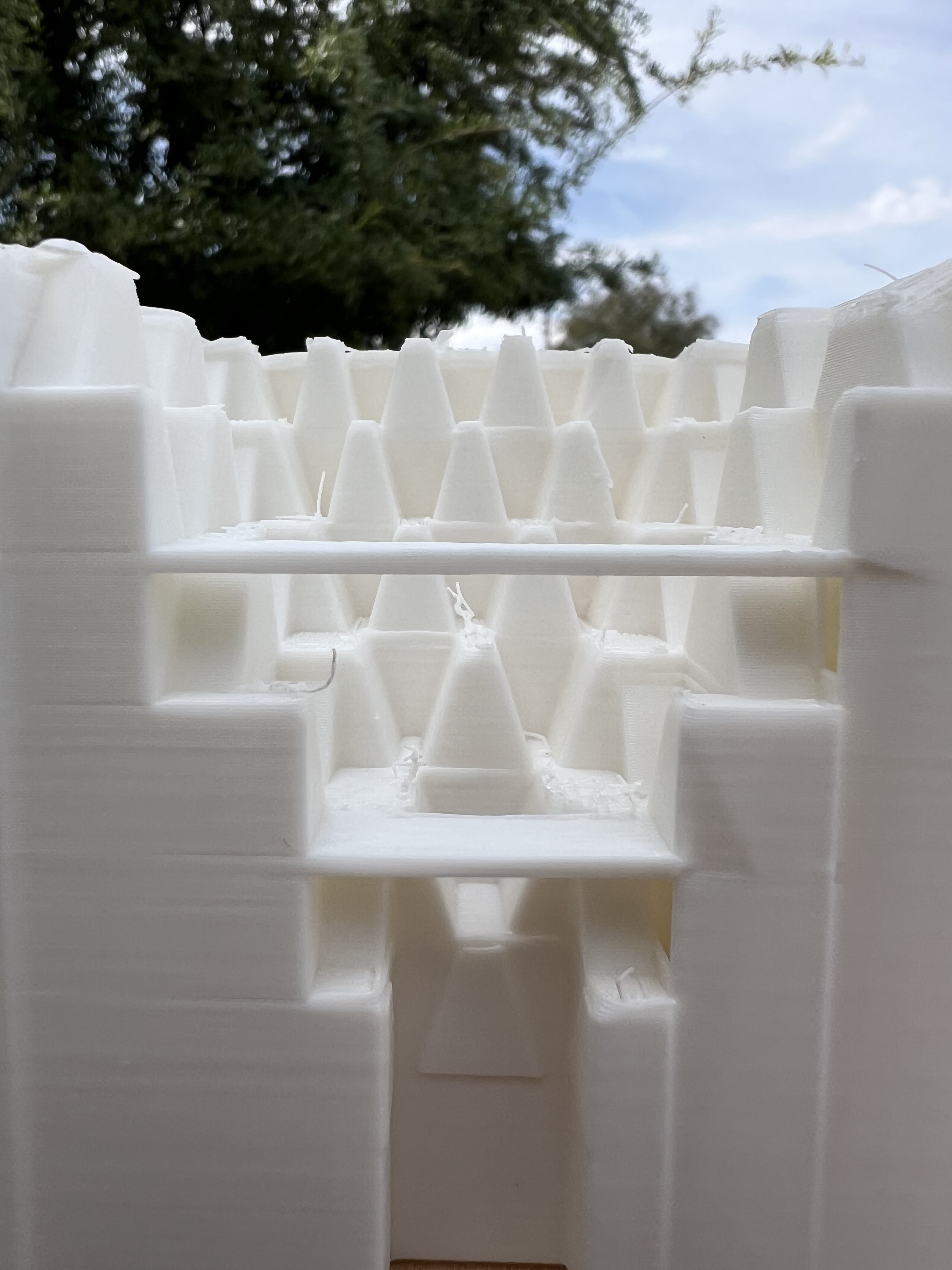
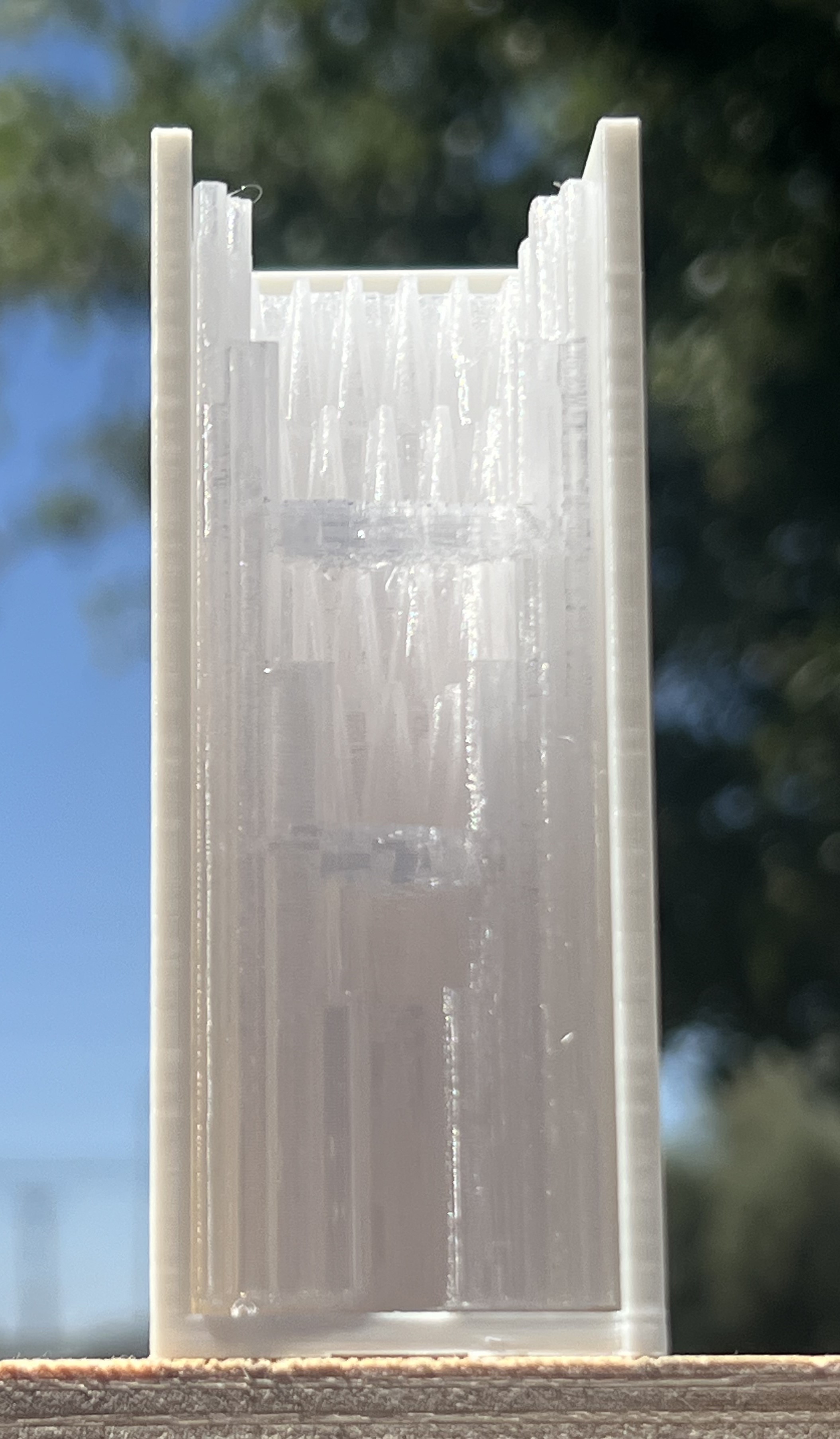
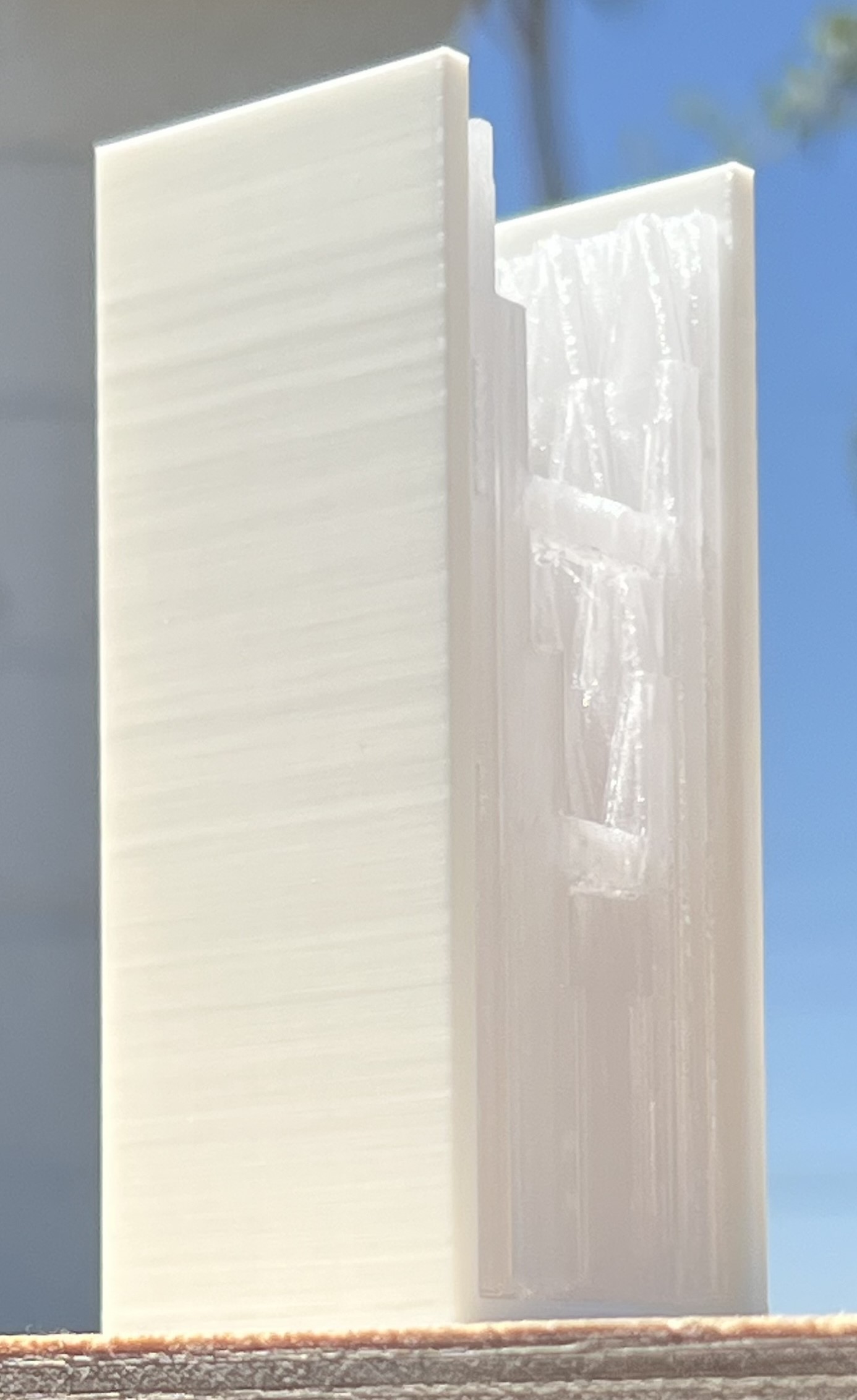
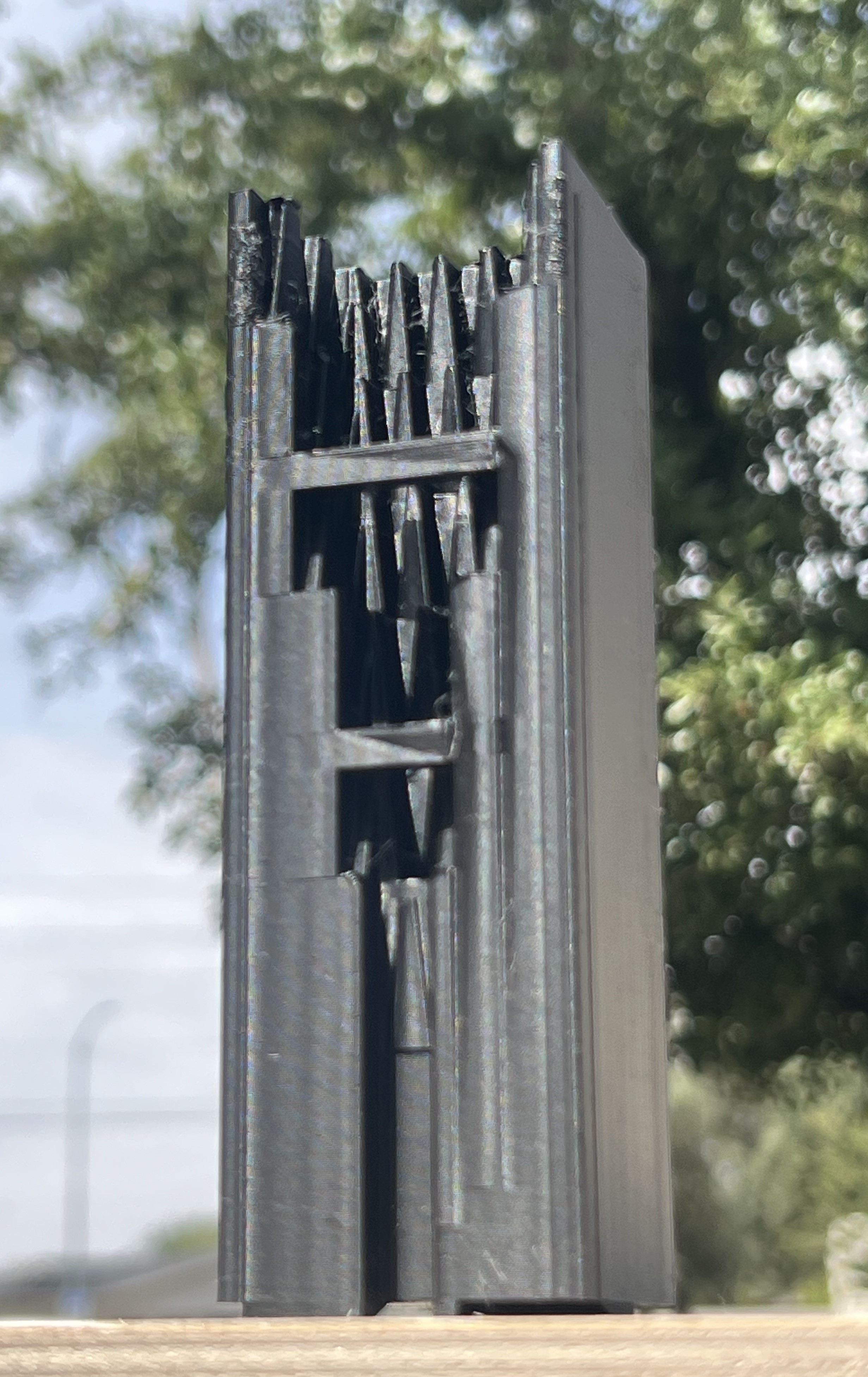
There is a desert notion of the sun angling or cutting away what is not sustainable and leaving a hardened thermally resistant outside and geodic crystal interior. This has been called “solar carve” and I made some explorations of the idea this week. Getting those optical angles and natural light and sunshine without the excess heat gain is the goal. Here are a few of my efforts.
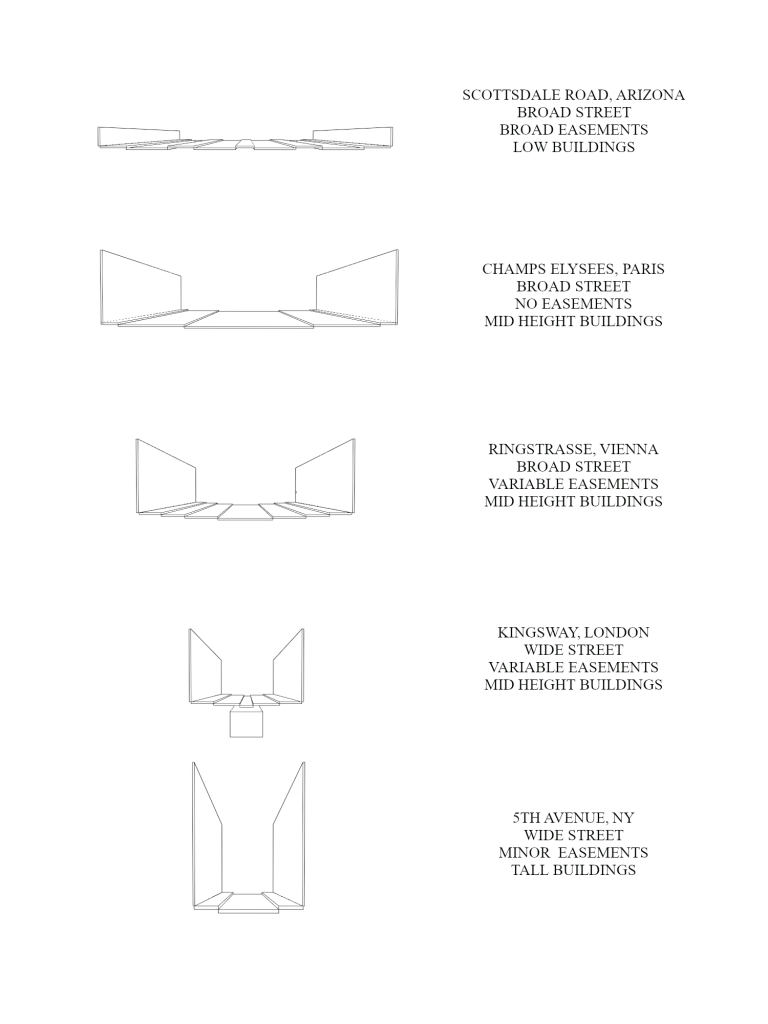
Drew these schematics the other day. Was thinking mostly about Scottsdale Road, near where I live. So many cars, not a lot of people, completely exposed to the scorching heat. There are some meagre trees and some more details and nuance but I just drew the height and width in an average.
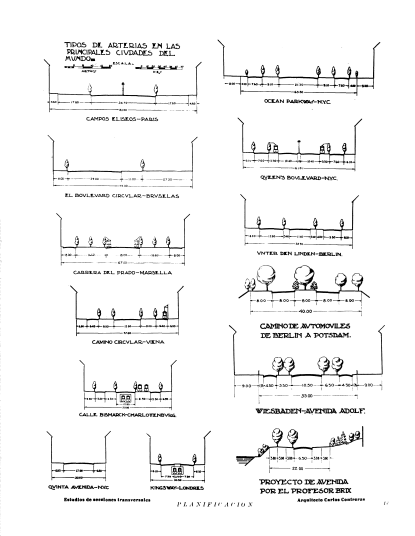
These drawings below (from 1920s journal Planificacion) by Architect Carlos Contreras were where I got the dimensions for the world cities I included. There are other studies of transverse sections out there, interesting to think about.
I will make this as clear and concise as I can. Let me know if this makes sense.
The question here is, why does the matter of form and content resonate with architecturally aligned writers ? What about formalism can cause critics to take issue?
The critique of formalism can dismiss work leaning too much towards form in a spectrum or scale of form and content. A prerequisite is a duality of form and content. Whether it should be or not, form and content have been construed in analogues such as the following:
Form is to exterior, as content is to interior.
Form is to book cover, as content is to writing.
Form is to bottle, as content is to fluid.
Form is to enclosure, as content is to program.
Form is to building, as content is to occupants.
NB: I do not subscribe or buy into these, but I see them, they are out there. Not sure how durable any analogy is. I see these, and most analogues or dichotomies as spectrums and scales where some degree of balance and synthesis may be found to optimize any design.
Rereading M.M. Bakhtin this week. This post was written in one sitting (broad brush) and is an intentionally incomplete (unfinished work in progress) essay. I will write something with a little closer reading soon, as I am waiting for more books that are on the way. What I have found interesting about Bakhtin’s writing, since I first read his work, is the same point of interest I have with respect to Immanuel Kant. That is, their philosophies often appeal to architectonics.
Bakhtin and Kant undoubtedly held quite different conceptions of architectonics. Should we associate Bakhtin’s sense of architectonics with the avantgarde of his time and place? I know these three modes I am about to mention are so vastly and fascinatingly different, but was anything other than a classical, rococo, or gothic conception of architectonics possible in Kant’s time and place?
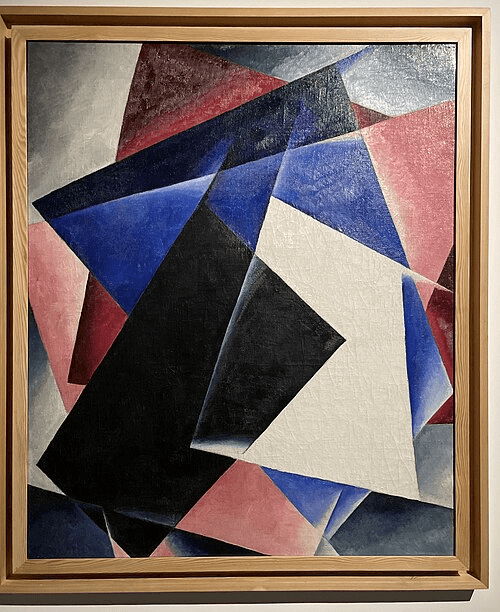
The 1910s and 1920s avantgarde developed a challenging and radical sense of architectonics. Artist visualizations from the time, might fit on a spectrum somewhere between Malevich’s “Architectons” and Popova’s “Painterly Architectonics”. Let us suppose there is some purity of geometry or trigonometry as it may be. Some mathematical functions involved to compound the forms and their barren angularity. Maybe the work is form only and no tone or the opposite, and it is a fragmentation of all colors. What might these options mean to a young philosopher such as Bakhtin, who wrote extensively about the “architectonics of seeing”? A more traditional and stable sense of Architectonics might gravitate in meaning towards order, structure, and their synonyms even while these notions were alternately evoked and banished by the architectural avantgarde.
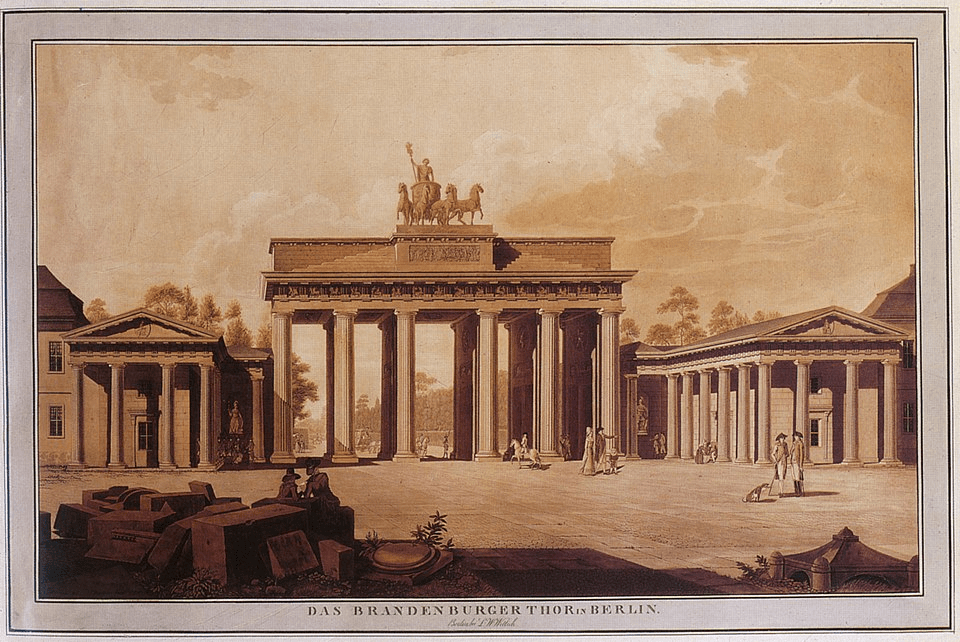
Architectonics is a rarely used word. It might mean different things to anyone asked, as architecture is so manifold. Where, when, how did architectonics enter the modern philosophical discourse? Who might have explored the topic in detail? It is certainly appealed to in the “Critiques” by Kant. In the 1780s,would architectonics have conjured in Kant’s mind some recent rococo or baroque or the turning away from those to Classicism or something else? Some archaeological idea of J.J. Winkelmann? Some kind of about to be built Brandenberg Gate? Classicism and its derivatives often lend themselves as supporting elements, imposing and reinforcing order, solidity, systemization, endurance.
[This quick essay draws on design and art to visualize what Bakhtin and Kant might be conjuring. Expect another post soon with more focus on the philosophical and philological implications, in text more solely]